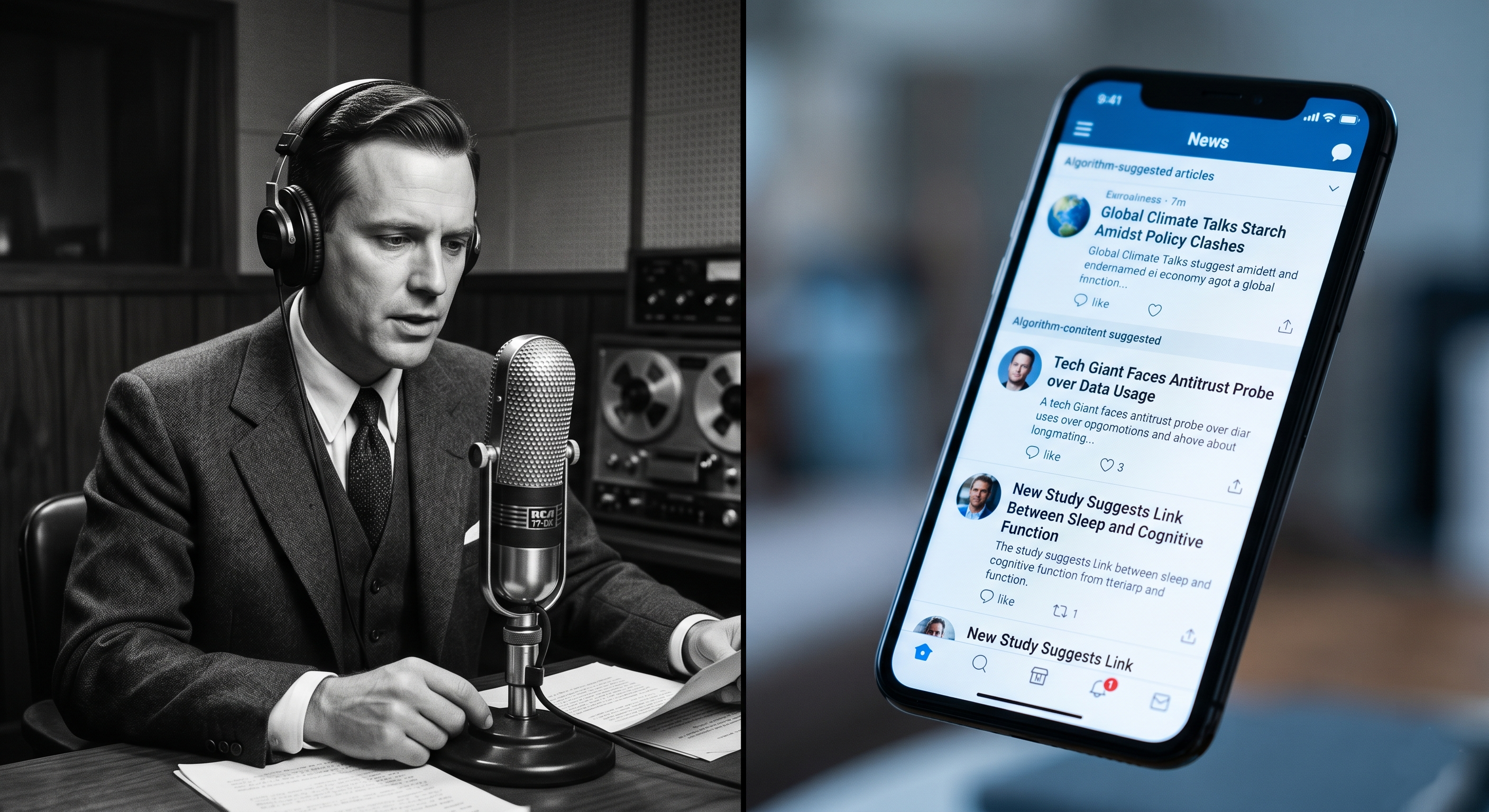


Tonight at 11 p.m., CBS News Radio will go silent for the last time.
It is more than just a moment in history having marked the transition from radio news to other sources. It is also about our online experiences guided by algorithms and AI that play a bigger role in how we get our news.
CBS News Radio is feeding more than a third of every news and talk radio station in America
For nearly a century CBS News radio has covered every meaningful news story you can think of. From Edward R. Murrow’s coverage of the London Bombings of World War II, Pearl Harbor, Watergate, 9/11 to every election in between. CBS News Radio provided those top-of-the-hour summaries across the country. Currently they serve 700 stations with their news feed. While there are about 15,000 radio stations, roughly 2,000 are dedicated to news and talk radio. Meaning CBS News Radio is feeding more than a third of every news and talk radio station in America. Those stations will find other sources but without CBS there are fewer choices, and that is just the point.
Just for You
Fewer people are getting their news from broadcast radio, and more are turning to social media instead. The journalism of those sources varies across a wide spectrum from everyday influencers to serious reporters. But that journey online is where radio and social media diverge.
Radio news does not target you. It doesn’t even know you are listening when you are stuck in traffic and hear the news sounder announcing CBS News Radio. There you would know that for decades the journalists behind the microphones were intent on providing unbiased, fact-based newscasts. Avoiding favoring aspects of their stories and audiences alike. They provided a type of professionalism bound by standards and journalistic integrity. While not all radio news reporting was perfect there was a process of vetting, verification and human judgement before stories were broadcast. Truth was a premium.
Social media in contrast, relies on what it knows about you before you get news in your “Just for You” feeds. Driven by engagement metrics and advertising revenue, rather than accuracy. Some listeners have responded deliberately, gravitating towards news podcasts they actively choose. But those very choices immediately become an input to AI and algorithms that will suggest your next story. Unlike radio, that seeks to serve wide audiences, your online news feeds narrows what news you see and read.
The New News
There is meaningful difference between AI assisted news selection and what you can find on your radio dial. News radio had the power to provide all the same information to the same people at the same time. Hearing facts together in effect builds a better community for dialog. It creates common knowledge, meaning not just that everyone knows a fact, but everyone knows that everyone else also knows it. Truth becomes more grounded. The dispersion of news sources fragments where we get information. It also contributes to a decline in trust in news given that much of the fragmentation has segregated people into biased information sources, reinforced by an algorithm.
Good Night, and Good Luck
The last broadcast of CBS News Radio is a place in time. It is another reminder that there are fewer newsrooms, fewer journalists, and fewer places to find unbiased information. It marks a moment when we once again need to recognize that the legacy institutions of information are being replaced by a rapidly advancing AI that often makes us question what is real and what can be trusted.
How we approach this new news era requires media literacy and AI awareness as an unprecedented skill. We need to be more deliberate in our choices of news and seek agency over the social media platforms that provide it.
Tonight it is worth pausing for CBS News Radio’s final signoff and to imagine the future with one less choice.

The real Edward R. Murrow.
Source: Encyclopedia Britannica
Discover more from Derek W Gibson
Subscribe to get the latest posts sent to your email.